13.05.2026
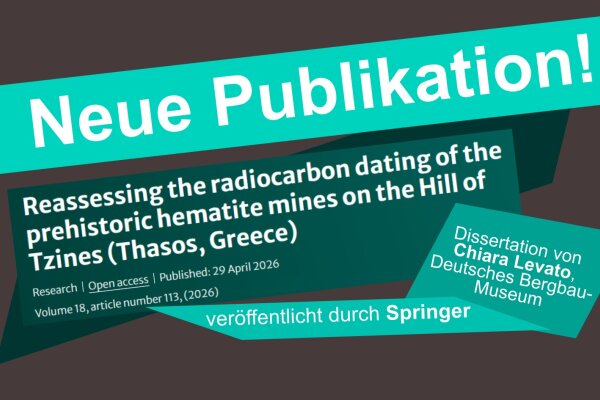
Ph.D. candidate Chiara Levato has successfully published her dissertation with Springer Verlag—shedding new light on prehistoric raw material extraction. In collaboration with the German Mining Museum in Bochum, her research focuses on the hematite mines on Tzines Hill on the Greek island of Thasos.
The site was first discovered in the 1950s during modern open-pit mining operations and was later archaeologically investigated. This revealed two underground mines (T1 and T2) where the iron-bearing mineral hematite—an important raw material for the production of ochre—was mined. For a long time, however, it remained unclear exactly when these mines were in use, as dating was complicated by poorly preserved bone material.
This is where the dissertation comes in: As part of a new radiocarbon dating program (2020–2021), samples were carefully selected, prepared, and analyzed using modern methods. Despite difficult conditions, new dates were successfully obtained—particularly for Mine T2. The results are remarkable: One date indicates that the mine was already in use around 28,000 years ago, that is, during the middle phase of the Upper Paleolithic (Gravettian). This makes mining on Thasos one of the earliest known examples of mining in Europe. A second, less certain dating also suggests that the mine may have been reused during the Holocene.
A second, less reliable dating also suggests that the mine may have been reused during the Neolithic period (Holocene).
This study places these findings within a broader context—ranging from the role of ochre in prehistoric cultures to environmental and animal remains, as well as alternative dating methods. It thus provides important insights into the early use of raw materials in the Aegean region and beyond.
With her dissertation, Chiara Levato makes a significant contribution to mining archaeological research and underscores the successful collaboration with the German Mining Museum in Bochum.
You can download the PDF under “Read more”
Ph.D. candidate Chiara Levato has successfully published her dissertation with Springer Verlag—shedding new light on prehistoric raw material extraction. In collaboration with the German Mining Museum in Bochum, her research focuses on the hematite mines on Tzines Hill on the Greek island of Thasos.
The site was first discovered in the 1950s during modern open-pit mining operations and was later archaeologically investigated. This revealed two underground mines (T1 and T2) where the iron-bearing mineral hematite—an important raw material for the production of ochre—was mined. For a long time, however, it remained unclear exactly when these mines were in use, as dating was complicated by poorly preserved bone material.
This is where the dissertation comes in: As part of a new radiocarbon dating program (2020–2021), samples were carefully selected, prepared, and analyzed using modern methods. Despite difficult conditions, new dates were successfully obtained—particularly for Mine T2. The results are remarkable: One date indicates that the mine was already in use around 28,000 years ago, that is, during the middle phase of the Upper Paleolithic (Gravettian). This makes mining on Thasos one of the earliest known examples of mining in Europe. A second, less certain dating also suggests that the mine may have been reused during the Holocene.
A second, less reliable dating also suggests that the mine may have been reused during the Neolithic period (Holocene).
This study places these findings within a broader context—ranging from the role of ochre in prehistoric cultures to environmental and animal remains, as well as alternative dating methods. It thus provides important insights into the early use of raw materials in the Aegean region and beyond.
With her dissertation, Chiara Levato makes a significant contribution to mining archaeological research and underscores the successful collaboration with the German Mining Museum in Bochum.
You can download the PDF under “Read more”

Copyright © ArchWiss 2026
Last update: May 13, 2026