04.08.2026
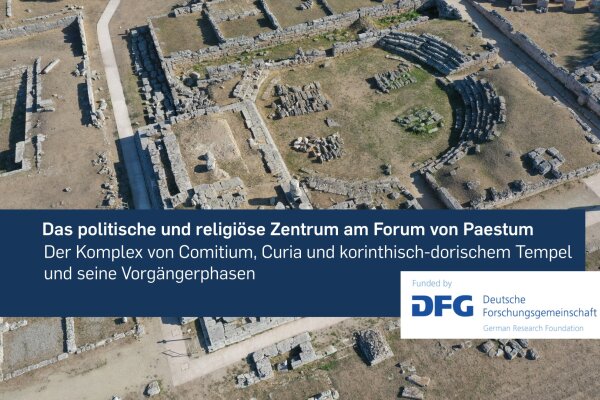
The German Research Foundation (DFG) is funding the project “The Political and Religious Center at the Forum of Paestum: The Complex of the Comitium, Curia, and Corinthian-Doric Temple and Its Predecessor Phases.” The goal is to reexamine the architectural history and function of one of Italy’s most significant ensembles of Republican architecture and to highlight its Greek and Roman developmental trajectories. We would like to express our sincere thanks to the DFG for its funding and for its confidence in this research project.
With funding from the German Research Foundation (DFG), the project “The Political and Religious Center at the Forum of Paestum: The Complex of the Comitium, Curia, and Corinthian-Doric Temple and Its Predecessor Phases” can intensify its research on the central public space of the ancient city.
The focus is on the extraordinary complex comprising the Comitium, the Curia, and the Corinthian-Doric temple at the Roman Forum of Paestum. Due to its state of preservation and its unusual architectural design, the ensemble is of outstanding importance for the study of Republican colonial architecture and urban planning in Italy. At the same time, key questions remain unanswered: the precise dating and reconstruction of the temple, its cultic function, and the sequence and significance of earlier construction phases.
Research to date has already shown that the development of the site was significantly more complex than previously assumed. New findings regarding predecessor structures, water conduits, construction phases, and reused building elements from the Greek Ekklesiasterion offer a new perspective on the transformation of the political and religious center from a Greek to a Roman city. The project combines archaeological excavations, architectural surveys, 3D documentation, and the analysis of architectural ornamentation to reconstruct this multifaceted history with greater precision.
We would like to express our sincere gratitude to the DFG for its funding, which makes this long-term, interdisciplinary research into a key site in ancient urban history possible.
The German Research Foundation (DFG) is funding the project “The Political and Religious Center at the Forum of Paestum: The Complex of the Comitium, Curia, and Corinthian-Doric Temple and Its Predecessor Phases.” The goal is to reexamine the architectural history and function of one of Italy’s most significant ensembles of Republican architecture and to highlight its Greek and Roman developmental trajectories. We would like to express our sincere thanks to the DFG for its funding and for its confidence in this research project.
With funding from the German Research Foundation (DFG), the project “The Political and Religious Center at the Forum of Paestum: The Complex of the Comitium, Curia, and Corinthian-Doric Temple and Its Predecessor Phases” can intensify its research on the central public space of the ancient city.
The focus is on the extraordinary complex comprising the Comitium, the Curia, and the Corinthian-Doric temple at the Roman Forum of Paestum. Due to its state of preservation and its unusual architectural design, the ensemble is of outstanding importance for the study of Republican colonial architecture and urban planning in Italy. At the same time, key questions remain unanswered: the precise dating and reconstruction of the temple, its cultic function, and the sequence and significance of earlier construction phases.
Research to date has already shown that the development of the site was significantly more complex than previously assumed. New findings regarding predecessor structures, water conduits, construction phases, and reused building elements from the Greek Ekklesiasterion offer a new perspective on the transformation of the political and religious center from a Greek to a Roman city. The project combines archaeological excavations, architectural surveys, 3D documentation, and the analysis of architectural ornamentation to reconstruct this multifaceted history with greater precision.
We would like to express our sincere gratitude to the DFG for its funding, which makes this long-term, interdisciplinary research into a key site in ancient urban history possible.

Copyright © ArchWiss 2026
Last update: Aug 04, 2026